TL;DR — Key Takeaways
- ISO 46000 builds stronger social responsibility practices by guiding organizations to operate ethically, transparently, and with genuine respect for people and communities.
- It improves stakeholder trust by aligning business conduct with global expectations on human rights, fair labour, and responsible governance.
- Certification lowers reputational and ethical risks by creating consistent systems that address social, environmental, and community-related responsibilities.
- Clear policies and structured accountability strengthen internal culture, helping teams act responsibly and make decisions aligned with organizational values.
- Rising demand for ethical businesses makes ISO 46000 a strategic advantage, enhancing credibility, sustainability, and long-term organizational resilience.
Today, responsible business practices matter more than ever, and ISO 46000 Certification helps companies show strong ethics, transparency, and social responsibility. Around 77% of consumers now prefer companies with visible CSR initiatives, showing how strongly social responsibility influences today’s market.
ISO 46000 helps businesses follow fair labour practices, protect human rights, care for the environment, and respect stakeholders. The certification boosts credibility and shows long-term commitment to doing the right thing, considering the complexity, working with Altus.Asia smooths the pathway and ensures accurate compliance.
What is ISO 46000?
ISO 46000 is an international standard for Social Responsibility (SR). It provides a structured approach for organizations to implement ethical, transparent, and sustainable practices in their operations.
It focuses on:
- Ethical governance
- Human rights
- Labour practices
- Fair operating behaviour
- Community development
- Environmental responsibility
- Consumer well-being
Whether you run a small business or a large enterprise, ISO 46000 helps you build trust and strengthen responsible decision-making.
Why ISO 46000 Certification Matters Today?
In today’s market, customers expect more than good products; they want responsible brands. ISO 46000 supports this shift by helping organizations:
- Strengthen brand reputation
- Build stakeholder trust
- Reduce ethical and operational risks
- Improve long-term sustainability
- Demonstrate corporate accountability
- Support global ESG expectations
When implemented well, the standard becomes a roadmap for responsible growth and transparent governance.
What are the Benefits of ISO 46000 Certification?
This section helps you understand how the certification strengthens your brand, improves trust, reduces risks, and supports responsible business practices that positively impact long-term growth.
1. Improves Business Ethics
It guides companies to operate with fairness, transparency, and accountability.
2. Strengthens Brand Reputation
Certified organizations stand out as responsible and trustworthy.
3. Supports ESG Goals
Helps align your operations with global environmental, social, and governance criteria.
4. Enhances Stakeholder Confidence
Investors, customers, and employees trust businesses with strong social responsibility systems.
5. Reduces Risks
By addressing governance gaps, ethical concerns, and sustainability issues.
6. Boosts Employee Morale
A responsible, safe, and respectful work environment increases engagement.
Who Should Get ISO 46000 Certification?
Here, you’ll discover which organizations gain the most value from this standard and why it suits businesses across different sectors aiming for ethical and sustainable operations.
It is ideal for:
- Manufacturing companies
- Service industries
- Educational institutions
- Government bodies
- IT and tech companies
- Healthcare providers
- NGOs and social enterprises
If your business interacts with communities, employees, customers, or the environment, this standard applies.
ISO 46000 Principles You Must Understand
Before implementing the standard, it’s important to learn its foundational principles. This section explains the core values that shape socially responsible and transparent business behaviour.
This standard is built around seven core principles:
- Accountability
- Transparency
- Ethical Behaviour
- Respect for Stakeholders
- Respect for the Rule of Law
- Respect for International Norms of Behaviour
- Respect for Human Rights
These principles serve as the foundation for a socially responsible organization.
Mandatory Requirements for ISO 46000 Certification
This part outlines the essential criteria your business must follow, helping you understand the documentation, processes, and responsibilities needed to meet certification expectations.
To get certified, your organization must:
- Establish a Social Responsibility policy
- Identify key stakeholders and their expectations
- Evaluate social, ethical, and environmental risks
- Implement responsible governance practices
- Build processes supporting human rights and fair labour practices
- Promote transparency and ethical decision-making
- Ensure monitoring, reporting, and continuous improvement
Documentation depends on the nature and size of your business.
Step-by-Step Process to Get ISO 46000 Certification
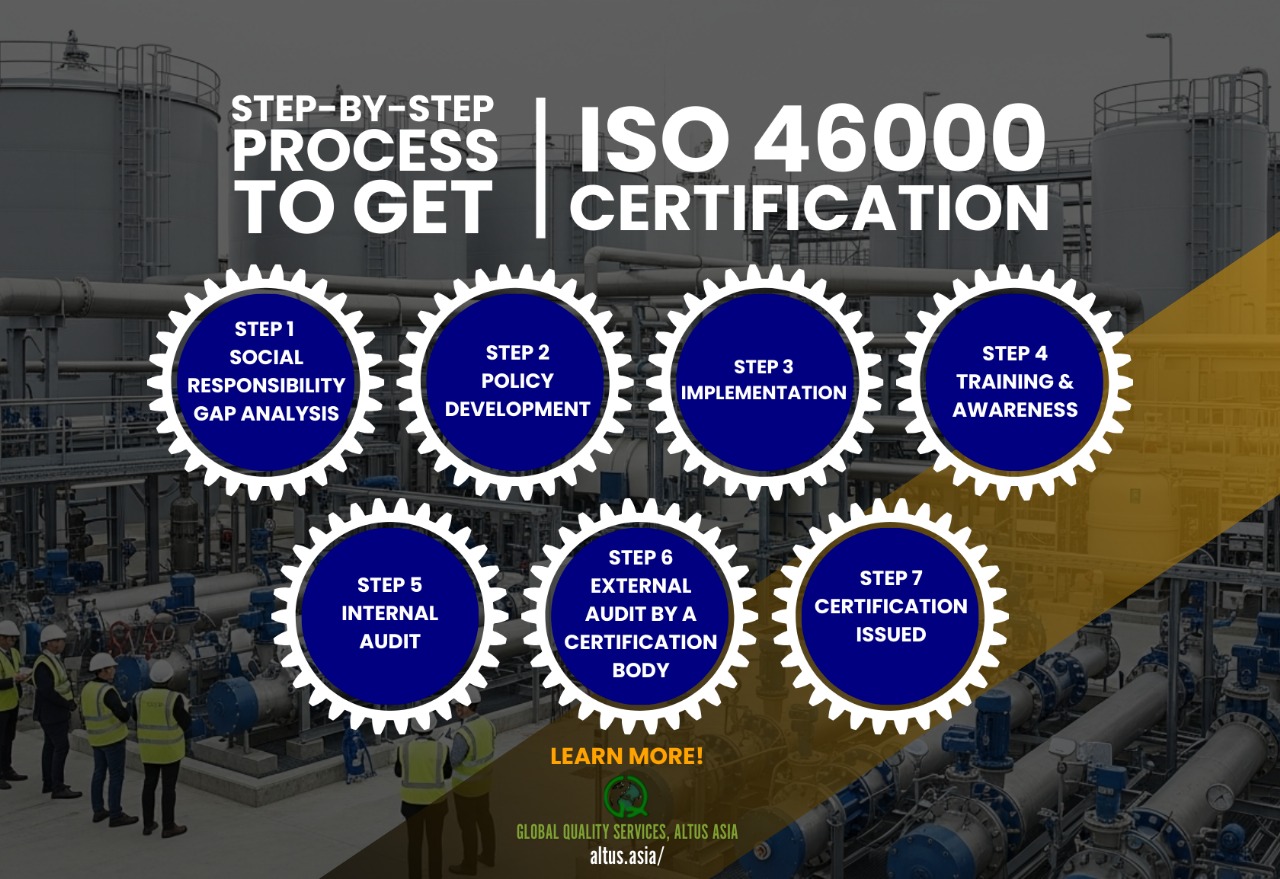
Here, you’ll walk through each stage of the certification journey, making it easier to understand what to prepare, implement, and review before your audit.
Step 1: Social Responsibility Gap Analysis
Assess current practices and identify what needs improvement.
Step 2: Policy Development
Create an SR policy aligned with ISO 46000 principles.
Step 3: Implementation
Introduce ethical, environmental, and social responsibility practices across departments.
Step 4: Training & Awareness
Educate your workforce on their roles in responsible operations.
Step 5: Internal Audit
Review compliance and close gaps before certification.
Step 6: External Audit by a Certification Body
A third-party auditor verifies your SR system.
Step 7: Certification Issued
Once approved, you receive the ISO 46000 certificate—valid for three years with annual surveillance audits.
How Long Does It Take to Get ISO 46000 Certified?
This section helps you estimate your certification timeline by explaining how business size, readiness, and process gaps influence the overall duration.
Certification timelines depend on company size and readiness:
- Small businesses: 4–8 weeks
- Medium enterprises: 2–3 months
- Large organizations: 3–6 months
A gap-free system speeds up the process.
Cost of ISO 46000 Certification
Here, you’ll get clarity on the cost factors involved, helping you understand how pricing varies based on company size, audit needs, and certification body.
Costs vary based on:
- Business size
- Number of employees
- Industry type
- Certification body
- Audit duration
Standard pricing ranges from ₹40,000 to ₹3,00,000 for Indian organisations.
Common Challenges During Implementation
Before starting your journey, this part prepares you by highlighting common difficulties organisations face and how the right planning can help overcome them smoothly.
- Lack of awareness of social responsibility components
- Difficulty identifying stakeholder needs
- Limited documentation or reporting framework
- Resistance to ethical behavioural change
- Inconsistent monitoring practices
Partner with Altus.Asia for ISO 46000 Certification
Partner with Altus.Asia to make your ISO 46000 Certification journey smooth, accurate, and stress-free. Our experts guide you through every requirement, ensure full compliance, and help you build a strong, responsible business reputation. Take the next step toward ethical excellence. Contact us today to get started.
FAQ’s
1. Does ISO 46000 integrate with other management systems like ISO 9001 or ISO 14001?
Yes, ISO 46000 integrates smoothly with existing systems. Its social responsibility framework complements quality, environmental, and safety standards, helping organizations create a more holistic, ethical, and sustainable management approach.
- Can small businesses or startups afford ISO 46000 Certification?
Yes, small businesses can afford it. Certification bodies offer scaled pricing, and implementation is flexible. The benefits of trust, reputation, and responsible practices often outweigh the investment for growing companies.
- Does ISO 46000 require annual reporting or public disclosures?
ISO 46000 encourages transparency but doesn’t mandate public reporting. However, organizations benefit from sharing progress to strengthen trust, stakeholder relationships, and overall social responsibility visibility.
- Is employee training mandatory for ISO 46000 implementation?
Yes, training is essential. Employees must understand ethical practices, responsibilities, and reporting processes to support consistent, organization-wide social responsibility aligned with ISO 46000 principles.
- Does ISO 46000 cover supply chain responsibility?
Yes, ISO 46000 extends to supply chains. It encourages fair labour, ethical sourcing, and responsible supplier behaviour, ensuring your organization maintains integrity beyond internal operations.